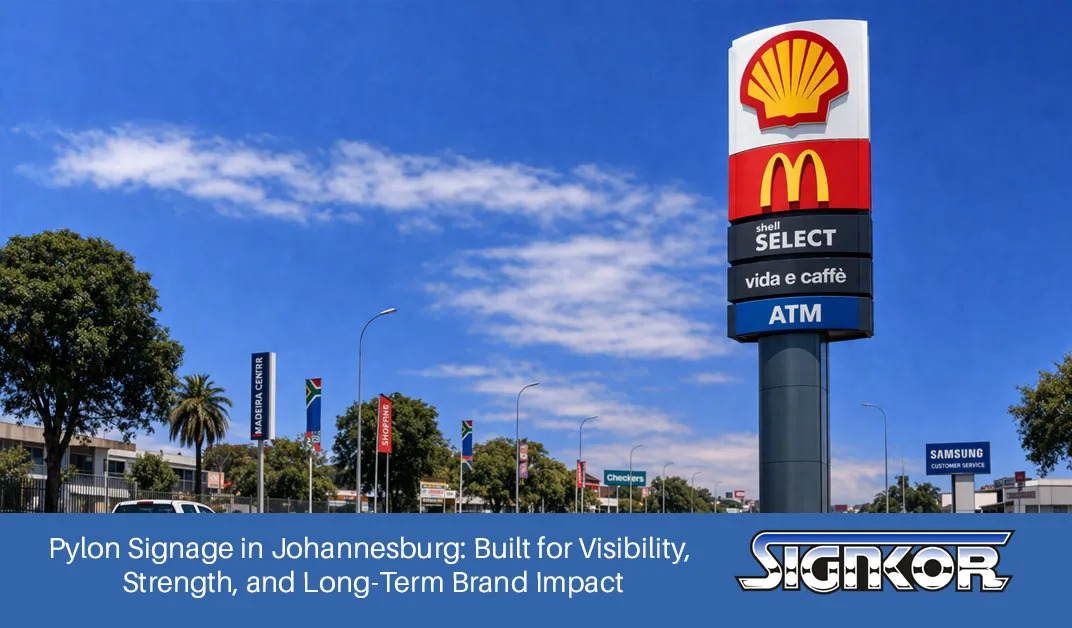
In a city as fast-moving and competitive as Johannesburg, visibility matters. Businesses need signage that does more than mark a location. It needs to capture attention, communicate authority, and help customers find a site quickly from a distance. That is exactly where pylon signage stands out.
For retail centres, fuel stations, business parks, dealerships, commercial developments, and industrial properties, pylon signage remains one of the most effective outdoor branding solutions available. Tall, prominent, and highly visible, a well-designed pylon sign helps a business claim space in the landscape and turn passing traffic into real awareness.
Signkor designs pylons according to the client’s brief. That means every project begins with the practical realities of the site, the client’s brand requirements, the desired visual impact, and the structural demands of the installation. After design approval, engineer’s drawings are obtained for structural detail, helping ensure that the final product is visually striking and structurally sound.
The result is a durable, high-visibility pylon sign manufactured for real-world performance in Johannesburg conditions.
Why Pylon Signage Matters in Johannesburg
Johannesburg is a city of movement. Commuters, delivery vehicles, shoppers, staff, and visitors are constantly navigating major roads, busy intersections, commercial precincts, and industrial zones. In that environment, standard wall signage is not always enough.
Pylon signage offers a much larger visual presence. Because it is elevated and freestanding, it can often be seen from further away than fascia signs or window graphics. This makes it especially useful for businesses positioned on busy roads, in multi-tenant sites, or in locations where buildings sit back from the street.
For many Johannesburg businesses, pylon signage helps with:
- stronger roadside visibility
- easier wayfinding
- improved brand presence
- better identification in crowded commercial areas
- increased awareness for multi-tenant properties
- a more established, professional appearance
A pylon sign often creates the first physical impression of a business. When it is well designed and properly manufactured, it sends a message of quality, permanence, and confidence.
What Makes a Great Pylon Sign?
Not all pylon signage performs equally well. The most effective signs balance design, structural integrity, visibility, and finish quality.
A great pylon sign should do three things well.
First, it should be easy to see. That means correct scale, smart positioning, clear branding, and a layout that can be read at speed and from a distance.
Second, it should be built to last. Outdoor signage in Johannesburg must cope with sun exposure, wind, rain, dust, and temperature changes. Materials and finishing matter.
Third, it should reflect the business accurately. A pylon sign is not just a directional marker. It is part of a company’s public identity.
This is why custom design is so important.
Signkor’s Approach to Pylon Signage
At Signkor, pylon signage is typically developed in close collaboration with the client. Rather than forcing a one-size-fits-all product onto every site, the process begins with the brief.
That brief may include:
- the type of business or development
- the location and traffic environment
- the desired sign height and visual impact
- branding guidelines and colour requirements
- the number of tenant panels or messaging zones
- illumination preferences
- installation and engineering considerations
Once the concept has been aligned with the client’s goals, the design is refined for approval. After approval, engineer’s drawings are obtained to provide the structural detail required for fabrication and installation.
This stage is essential. Large freestanding signage must be engineered correctly to ensure structural reliability and compliance. It is not enough for a pylon to look impressive. It must be able to perform safely and dependably over time.
From Client Brief to Engineered Structure
One of the biggest differences between a basic sign and a high-quality pylon sign is the process behind it.
A successful pylon project usually moves through several stages:
- Discovery and brief development: This is where the purpose of the sign becomes clear. The client’s location, branding, site conditions, and visibility goals are all considered.
- Concept design: The visual design is developed around the brief. This includes branding placement, proportions, structural form, panel arrangements, and overall visual impact.
- Approval: Once the client is satisfied with the design direction, approval is given to move forward.
- Engineer’s drawings: Structural detail is finalised through engineering drawings. This helps ensure that the pylon will be manufactured and installed as a structurally sound product.
- Manufacturing: The pylon is fabricated from steel and prepared for outdoor durability.
- Finishing: Depending on project requirements, the steel is either galvanised or shot blasted and primed before the required structural colour is spray painted.
- Installation: The completed structure is installed on site as a high-visibility signage solution built for long-term use.
This process helps Signkor produce pylon signage that combines visual strength with structural confidence.
Why Steel Is Used for Pylon Signage
Pylon signs need a robust internal structure. Because they are tall, exposed, and permanently installed outdoors, the frame and body must be strong enough to support the sign’s height, panels, and wind load.
That is why Signkor manufactures pylons from steel.
Steel offers the strength needed for large freestanding signage, while also allowing for a wide range of custom structural forms. It provides the stability required for long-term outdoor use and supports a high-quality finished appearance.
The way the steel is prepared also matters.
According to Signkor’s process, pylons are either galvanised or shot blasted and primed before the structure is spray painted in the required colour. These preparation methods help protect the steel and support a durable finish suited to exterior conditions.
For businesses in Johannesburg, that translates into signage that is not only visually impactful on day one, but built with durability in mind.
The Value of Galvanising or Surface Preparation
Outdoor signage is always exposed to the elements. Moisture, pollution, strong sun, and everyday wear can all affect performance over time.
That is why the preparation stage is so important.
When a pylon is galvanised, the steel receives protective treatment that helps resist corrosion. Where galvanising is not used, shot blasting and priming help prepare the surface properly before paint is applied.
The final spray-painted finish then delivers the required brand colour and visual presentation.
Together, these steps contribute to:
- longer-lasting appearance
- better resistance to environmental wear
- improved structural protection
- a cleaner, more professional finish
- greater value over the lifespan of the sign
For a Johannesburg business investing in landmark signage, build quality is not a minor detail. It is central to performance.
Industries That Benefit from Pylon Signage in Johannesburg
Pylon signage works across a wide range of sectors because it solves a universal problem: how to be seen clearly.
It is especially effective for:
- Retail centres and shopping complexes: Pylons help display centre names, anchor tenants, and directional branding from high-traffic roads.
- Fuel stations and forecourts: Tall signage is vital for roadside visibility, especially where multiple services need to be displayed.
- Office parks and commercial buildings: Pylon signage helps tenants and visitors identify the site quickly while presenting a more premium exterior image.
- Motor dealerships: Vehicle brands need high-impact visibility from major routes. Pylons support both brand recognition and location awareness.
- Industrial parks and logistics sites: Freestanding signage helps customers, suppliers, and fleet drivers locate premises efficiently.
- Healthcare and educational campuses: Clear wayfinding and landmark signage can improve navigation on larger properties.
In each of these cases, the pylon is more than a sign. It becomes part of how the site functions and how the brand is perceived.
Customisation Makes the Difference
Because most pylon signage is designed around the client brief, the end result can be tailored in ways that standard signage cannot.
Customisation may include:
- overall height and scale
- shape and profile
- colour matching
- branding layout
- panel configuration
- tenant directories
- illuminated elements
- cladding and finish choices
This design flexibility is important in Johannesburg, where sites differ so much in traffic flow, access points, visibility lines, and surrounding architecture.
A custom pylon sign allows the signage to respond to the site instead of fighting against it.
Why High Visibility Is Only Part of the Job
It is tempting to think of pylon signage as simply “big signage”. But size alone is not what makes it effective.
A successful pylon sign must also communicate clearly.
That means:
- logos should be legible
- wording should be minimal and easy to read
- contrast should be strong
- the layout should prioritise the most important information
- the design should not feel cluttered
The best pylon signage combines distance readability with brand consistency. It should be easy to understand in seconds, whether someone is driving past, approaching the entrance, or scanning for a particular business.
Pylon Signage as a Long-Term Investment
A professionally designed and manufactured pylon sign is not a throwaway marketing asset. It is long-term infrastructure.
Unlike many short-term advertising channels, pylon signage keeps working every day. It supports branding, site recognition, and wayfinding without recurring media spend. Over time, that makes it a strong investment for businesses that rely on physical location visibility.
It can also contribute to:
- stronger local brand recall
- higher perceived credibility
- better customer convenience
- improved tenant exposure
- enhanced site identity
For new developments, established commercial sites, and rebrands alike, pylon signage often delivers both practical and brand value.
What Johannesburg Businesses Should Look for in a Pylon Sign Supplier
Choosing a pylon signage partner is about more than design flair. It is about process, engineering, fabrication quality, and understanding how to turn a brief into a real structure.
A good supplier should be able to offer:
- custom design aligned with your brand
- collaboration around your site needs
- structural engineering input
- strong material quality
- proper surface preparation and finishing
- a final product built for durability and visibility
Signkor’s process reflects that thinking. By designing in conjunction with the client brief, obtaining engineer’s drawings after approval, and manufacturing from steel with protective finishing, we deliver pylon signage built to perform in the real world.
FAQs About Pylon Signage
What is pylon signage?
Pylon signage is a tall, freestanding sign structure designed to provide strong visibility from a distance. It is commonly used for retail sites, commercial developments, fuel stations, business parks, and industrial premises.
Why is pylon signage effective for Johannesburg businesses?
Johannesburg has busy roads, high traffic flow, and many commercial nodes. Pylon signage helps businesses stand out in these environments by improving visibility, wayfinding, and brand presence.
What materials are used in Signkor’s pylon signs?
Signkor’s pylons are manufactured from steel. They are either galvanised or shot blasted and primed before the required structural colour is spray painted.
Why are engineer’s drawings important for pylon signage?
Engineer’s drawings provide the structural detail needed to help ensure the pylon is safe, stable, and suitable for long-term outdoor installation.
Can pylon signage be customised?
Yes. Most pylon signs are designed in conjunction with the client brief, allowing for customised branding, size, layout, colour, and structure.
Is pylon signage suitable for multi-tenant properties?
Yes. Pylon signs are often an excellent choice for shopping centres, office parks, and mixed-use developments where multiple businesses need visibility on one structure.
How long does pylon signage last?
The lifespan depends on design, materials, finishing, installation quality, and maintenance. Steel construction with proper protective treatment and finishing supports durability over time.
What should businesses consider before installing a pylon sign?
They should consider location, sign height, readability, branding, site visibility, structural requirements, and the long-term durability of materials and finishes.
Contact Signkor
Pylon signage remains one of the most powerful outdoor branding tools for businesses that need to be seen clearly and remembered quickly. In Johannesburg, where visibility, access, and first impressions matter, a well-made pylon sign can transform how a business or property is experienced from the road.
With Signkor’s client-led design process, engineer-backed structural detailing, and steel manufacturing approach, businesses can invest in pylon signage that is both visually striking and structurally sound. From concept to finish, every stage contributes to a final product built for performance, durability, and standout presence.
For businesses that want more than standard signage, a custom pylon offers scale, authority, and lasting value.
If your business needs standout pylon signage in Johannesburg, Signkor can help you create a solution that is engineered for strength and designed for visibility.
Contact Signkor today to discuss your client brief, site requirements, and branding goals. Our team will work with you to develop a custom pylon sign that delivers lasting impact for your business.