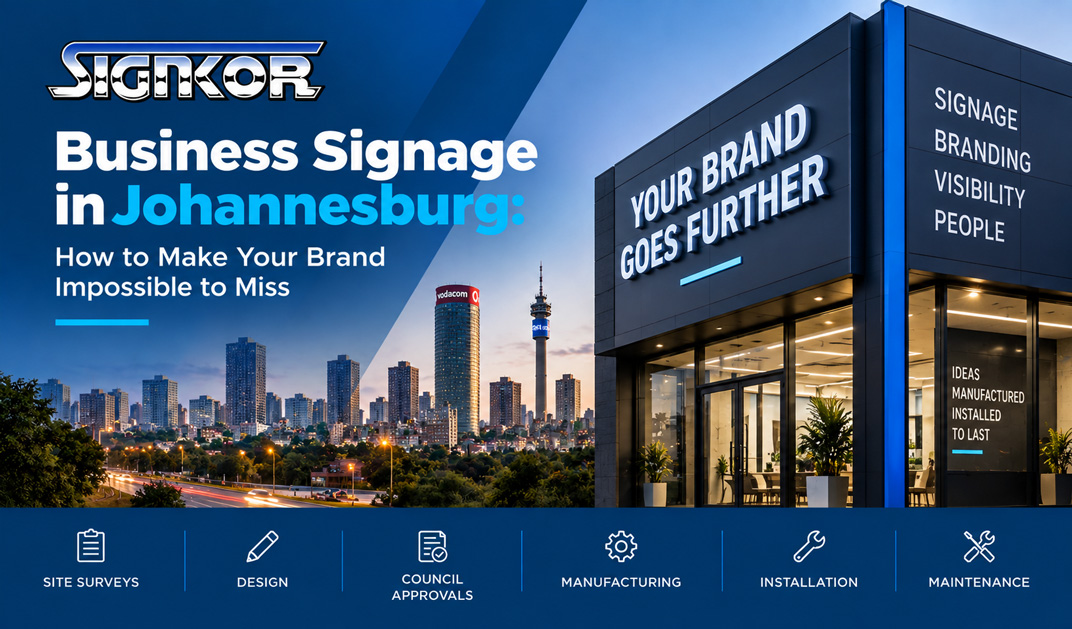
Johannesburg is not exactly a city where businesses can afford to whisper.
From packed shopping centres and busy arterial roads to office parks, industrial areas, dealerships, restaurants, and retail stores, brands are competing for attention almost everywhere you look. In this environment, a small, forgettable sign can disappear into the background surprisingly quickly.
Great signage does the opposite.
The right business signage Johannesburg companies invest in helps people notice your brand, recognise it, remember it, and, perhaps most importantly, find you. Whether you need a bold pylon beside a busy road, illuminated letters above a shopfront, window branding, or professional signage throughout a corporate space, signage is one of the most visible parts of your brand.
Signkor believes signage should do more than display a name. It should work for your business.
Why Business Signage Matters in Johannesburg
Think about how often signage influences your day without you consciously noticing it. You use signs to find the entrance to a shopping centre, identify a restaurant from across the road, navigate an office building, locate a shop, or recognise a familiar brand while driving.
That makes signage both a branding tool and a practical communication tool.
Well-designed business signage in Johannesburg can help you:
- Create a strong first impression
- Make your premises easier to identify
- Increase visibility from passing traffic
- Reinforce your corporate identity
- Build familiarity and brand recognition
- Guide customers around your property
- Give your premises a more professional appearance
Unlike a short-term advertising campaign, permanent signage keeps working whenever customers pass your location.
And, in Johannesburg, there can be a lot of passing traffic.
What Type of Business Signage Should You Choose?
There is no universal sign that works for every business. A retail store inside a shopping centre has very different needs from a dealership alongside a major road or a corporate head office in an office park.
The trick is choosing signage according to your location, audience, viewing distance, brand, and objectives.
Fascia and Shopfront Signage
Your shopfront may be one of the first physical interactions a customer has with your business, so it needs to make the right impression.
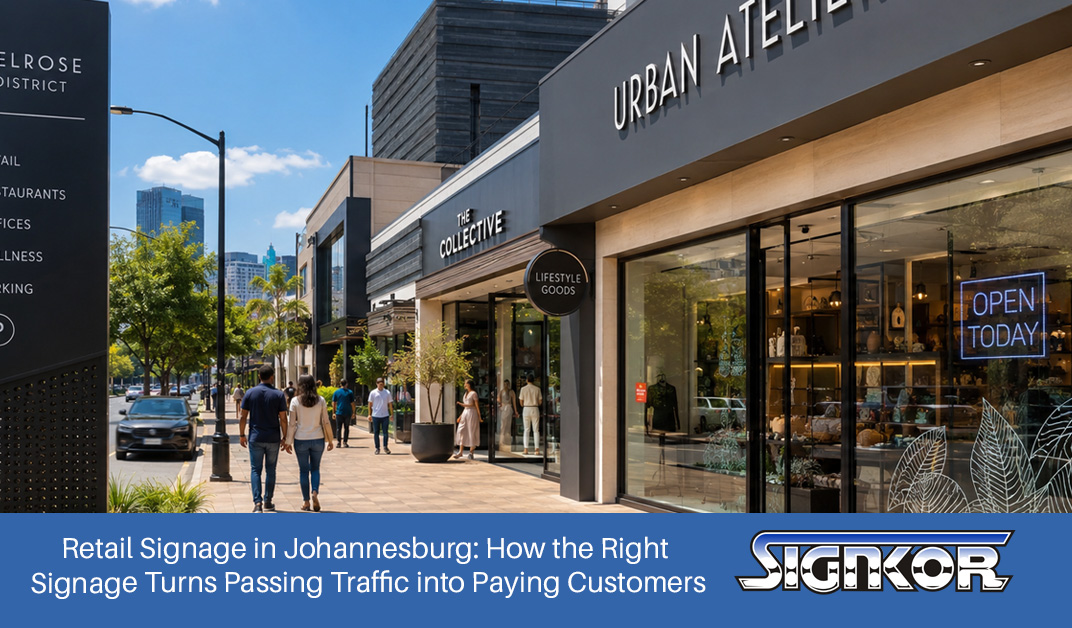
Fascia signage can prominently display your company name, logo, and branding across the front of a building or store. Depending on the application, it can be illuminated or non-illuminated and designed to complement the surrounding architecture.
For retailers, restaurants, showrooms, and customer-facing businesses, effective fascia branding can make the difference between blending into a row of shops and immediately catching someone’s eye.
3D Signage and Lettering
Sometimes flat simply isn’t enough.
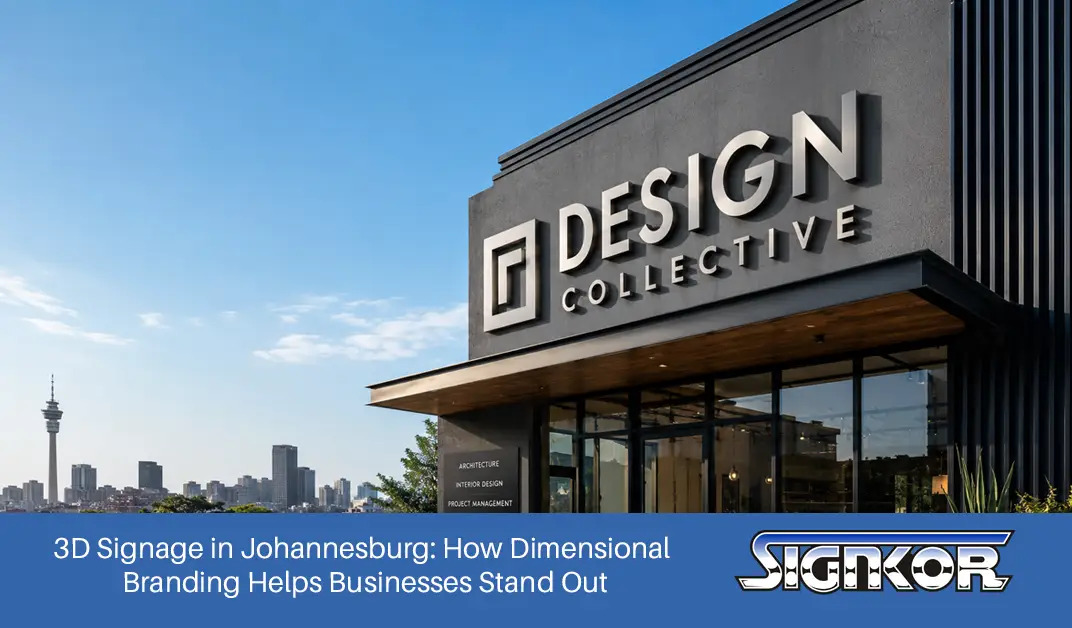
Three-dimensional letters add depth, shadow, texture, and a more architectural quality to a sign. They can give a reception area, shopfront, corporate office, hotel, or commercial property a polished, premium appearance.
Perspex can be fabricated into dimensional lettering and combined with illumination for greater visual impact. Other materials and fabrication techniques can also be used to produce signage that fits the personality and positioning of the brand.
The goal is not to make a sign complicated. It is to make it memorable.
LED and Illuminated Signage
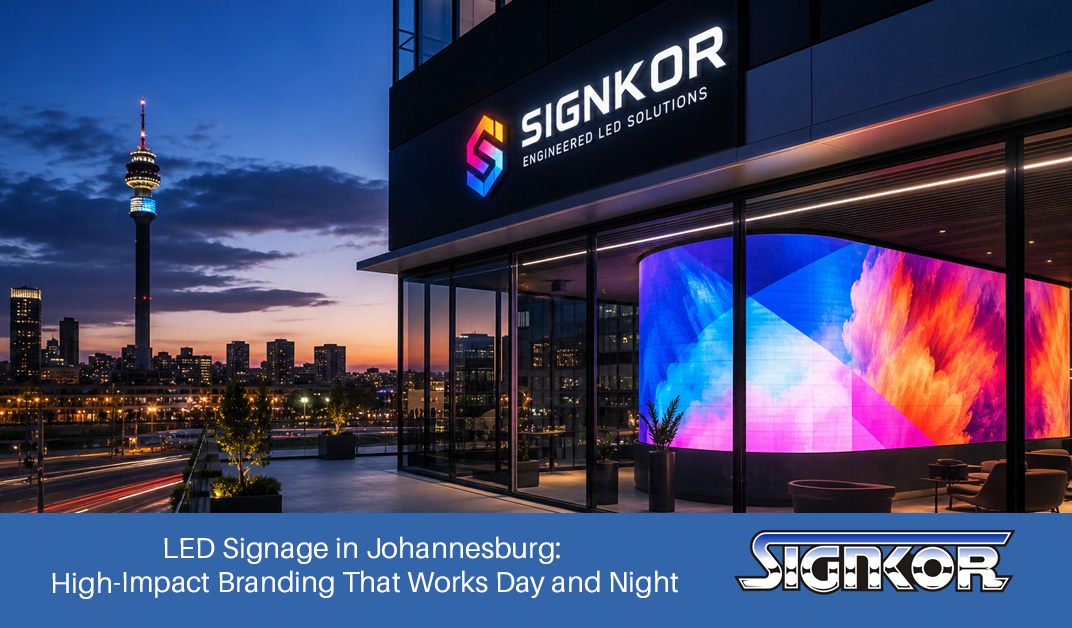
Johannesburg businesses don’t pack up when the sun goes down, and neither should their branding.
LED and illuminated signage can improve visibility in low-light conditions while creating a modern, eye-catching appearance. It is particularly useful for restaurants, retailers, entertainment venues, dealerships, shopping centres, hospitality businesses, and premises operating into the evening.
LED technology can also be incorporated into digital displays where businesses need more dynamic content.
Illumination should always have a purpose. Done properly, it enhances the brand. Done badly, it can turn your carefully designed identity into something that resembles a very enthusiastic Christmas tree.
Pylon Signage
If customers need to spot you from a distance, going upwards can make plenty of sense.
Pylons are freestanding signs designed to create visibility from roads, entrances, parking areas, and other high-traffic locations. They are particularly useful for shopping centres, business parks, fuel stations, automotive dealerships, industrial premises, and sites shared by several businesses.
Because pylons can become prominent structures, their design needs to balance visibility, branding, structural requirements, and the characteristics of the site.
Vinyl and Window Branding
Not every branding opportunity needs a giant structure.
Windows, glass doors, vehicles, counters, and other surfaces can become valuable branding space through professionally applied vinyl.
Window graphics can feature branding, promotional messages, operating information, decorative elements, or privacy treatments. Vehicle graphics can turn company cars, vans, and fleets into mobile brand assets.
It is a wonderfully simple idea: if you already have a surface, why leave it blank?
Interior and Wayfinding Signage
Good signage doesn’t stop at the front door.
Once customers, visitors, or employees enter a building, signage can help them understand where they are and where they need to go.
Interior signage can include reception branding, directional signs, department identifiers, room signs, safety information, and branded environmental graphics.
In larger retail centres, hospitals, corporate campuses, industrial facilities, and office buildings, effective wayfinding is particularly important. Nobody enjoys wandering around a building wondering whether “Reception →” secretly meant “begin an unexpected 20-minute adventure”.
Indoor vs Outdoor Signage in Johannesburg
Indoor and outdoor signage may perform similar branding functions, but their practical requirements can be very different.
Outdoor signage needs to cope with Johannesburg’s sunshine, rain, thunderstorms, dust, temperature changes, and prolonged exposure to the elements. Materials, finishes, fixings, illumination, and structural design therefore need to suit the environment.
Indoor signage has different priorities. Viewing distances are usually shorter, people may spend more time looking at the sign, and finishes can become an important part of the interior design.
When choosing between signage options, consider:
- Where the sign will be positioned
- How far away people will view it
- Whether viewers will be walking or driving
- Daytime and night-time visibility
- Available lighting
- Building materials and architecture
- Exposure to weather
- Required lifespan
- Brand guidelines
- Maintenance requirements
The best-looking sign on a computer screen is not necessarily the best-performing sign once installed. Context matters.
Designing Signage That Gets Noticed
A sign does not have to shout to be noticeable.
In fact, some of the strongest signage is remarkably simple.
The most important consideration is whether people can understand it quickly. That means prioritising the essentials: your company name, logo, brand identity, and, where necessary, a short message or directional cue.
Effective signage design generally considers contrast, typography, scale, positioning, lighting, viewing distance, and the surrounding visual environment.
A beautiful typeface that cannot be read from the road is not doing its job.
Likewise, squeezing seven messages, three phone numbers, a website address, four photographs, and your entire company mission statement onto a sign is unlikely to improve its effectiveness.
Strong signage gives the eye somewhere to go.
Johannesburg Signage and Council Approval
One part of a signage project that businesses can easily underestimate is compliance.
Depending on the type, size, structure, position, and location of a proposed sign, relevant approvals may be required before installation can go ahead.
That is one reason choosing an experienced signage company in Johannesburg can simplify the process.
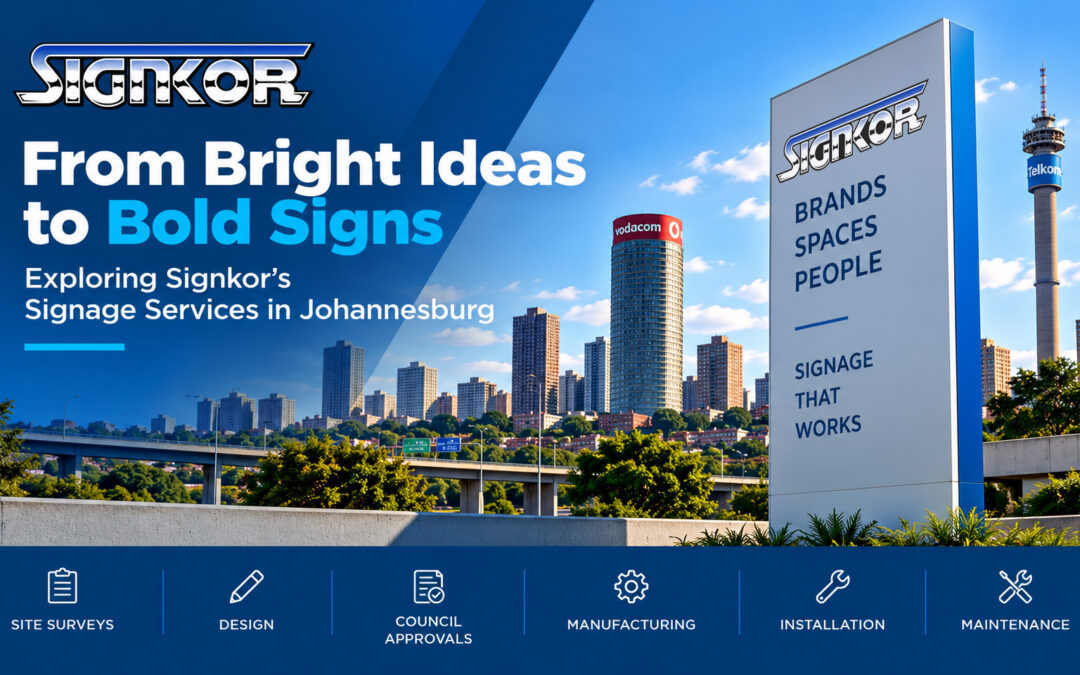
Our broader signage service can include site surveys, assistance with council applications, visual presentations and prototyping, project management, installation planning, and maintenance.
Looking at the project as a whole helps identify potential complications before manufacturing and installation begin.
From Signage Concept to Installation
Great signage begins long before anyone arrives with a ladder.
A professional signage project typically moves through several stages.
Understanding the Brief: What does the sign need to achieve? Who needs to see it? Where will it be installed? What does the brand need to communicate? These questions help determine the appropriate signage solution.
Site Survey: A site survey provides important information about dimensions, positioning, visibility, access, existing structures, installation requirements, and other practical considerations.
Design and Visualisation: The proposed signage can then be developed around the customer’s branding and the characteristics of the location. Visual presentations and prototypes can help stakeholders understand how the finished signage is likely to look before production begins.
Approvals: Where necessary, the appropriate signage approvals can be addressed before installation.
Manufacturing: Once the design is approved, the sign moves into production using the materials, fabrication methods, finishes, graphics, and illumination required for the project.
Installation: Professional installation ensures the finished sign is positioned correctly and delivers the visual impact intended during the design phase.
Maintenance: Signs live in the real world. They gather dust, face weather, experience wear, and occasionally need repairs. Cleaning, polishing, replacing damaged or missing components, and carrying out restoration work can help extend the life and appearance of signage.
Why Quality Matters for Johannesburg Signage
Price naturally matters when comparing signage quotations, but the cheapest sign is not necessarily the least expensive option over its lifetime.
Materials, manufacturing quality, structural design, finishes, illumination, installation, and maintenance can all affect how long signage lasts and how good it looks along the way.
Remember that your sign represents your business every day.
Faded graphics, damaged panels, unreliable lighting, peeling vinyl, or poorly aligned lettering can create an impression you probably did not include in the branding brief.
Quality commercial signage in Johannesburg should be designed around both visual impact and long-term performance.
Choosing a Signage Company in Johannesburg
Before appointing a signage provider, look beyond the price at the bottom of the quotation.
Ask whether the company can manage the complete project and whether it has experience with the type of sign you require.
Useful questions include:
- Can they conduct a site survey?
- Can they help develop and visualise the design?
- Do they manufacture the type of signage you require?
- Can they assist with relevant council applications?
- Do they handle installation?
- Can they manage larger or multi-site signage projects?
- Do they offer maintenance?
- Can they provide different signage solutions as your business grows?
Working with one experienced signage partner can be particularly valuable when a project combines several elements, such as pylons, fascia branding, window vinyl, 3D lettering, illuminated signage, and interior wayfinding.
Make Your Business Stand Out with Signkor
Johannesburg is busy, competitive, colourful, and constantly moving. Your signage needs to earn its place in that environment.
Whether you are opening a new location, refreshing tired branding, rolling out signage across multiple sites, or simply replacing one very important sign, Signkor can help develop a solution suited to your business, brand, and location.
From site surveys and visualisation to manufacturing, council applications, project management, installation, and maintenance, we approach signage as a complete project rather than just another item to hang on a wall.
If you’re looking for business signage Johannesburg customers can notice, recognise, and remember, talk to Signkor about turning your branding into something that stands out in the real world.
FAQs About Business Signage in Johannesburg
What is the best signage for a business in Johannesburg?
The best signage depends on your premises, industry, audience, and visibility requirements. Retail businesses may benefit from fascia, illuminated, window, and interior signage, while roadside premises may need highly visible pylon signage. A site assessment can help determine the right option.
How much does business signage cost in Johannesburg?
Signage costs vary considerably according to size, materials, design complexity, illumination, fabrication, structural requirements, installation, and quantity. Custom signage should therefore be quoted according to the specific project rather than treated as a one-size-fits-all product.
Do I need council approval for business signage in Johannesburg?
Some signage may require municipal approval depending on factors such as its type, position, dimensions, and structure. It is important to establish the relevant requirements before proceeding with installation.
What is the difference between illuminated and non-illuminated signage?
Illuminated signage incorporates a lighting solution to improve visibility and visual impact, particularly at night or in darker environments. Non-illuminated signage relies on surrounding light and can be an effective option for indoor applications, well-lit locations, and businesses that do not require night-time visibility.
Can Signkor design, manufacture, and install business signage?
Yes. Signkor provides signage solutions supported by services such as site surveys, graphic presentation and prototyping, assistance with council applications, project management, installation planning, and ongoing maintenance, allowing businesses to manage their signage requirements through an experienced signage partner.